

A framework for platform engineering leaders navigating the move from AI-assisted to AI-autonomous pipelines, and why governance can’t wait.
Key Highlights
- Enterprise agentic AI adoption follows a predictable 4-stage gradient, and most organizations are at Stage 1- 2 today
- Stage 3 (bounded autonomous execution) is arriving faster than governance programs planned for
- The OpenClaw exposure is the clearest case study of Stage 3 adoption without Stage 3 governance
- The load-bearing controls are agent-level, not gateway-level: scoped credentials, fail-closed defaults, tamper-evident logs
- Organizations that build governance one stage ahead of adoption turn each transition into a config change, not a security firedrill
What is agentic AI governance in software delivery?
Agentic AI governance is the set of controls, scope definitions, approval gates, credential policies, and audit trails, that determine what an AI agent is authorized to do inside a software delivery pipeline, and whether that authorization is verifiable after the fact. It operates at the agent level, not just the gateway level.
The question landing in technology leadership meetings right now is rarely "should we adopt agentic AI?" It's the harder, more practical one: What does our next stage look like, and what do we need in place before we get there?
That's the question most AI coverage fails to answer.
The dominant narrative swings between hype and alarm — "everything changes now" on one end, "no one is ready for it” on the other. Neither frame is useful to a platform engineering leader who is already running controlled pilots, thinking in phases, and trying to build a governance model that won't need rebuilding every six months.
The more honest framing: adoption is staged, deliberate and already underway. Organizations are not adopting agentic AI overnight, and they know it. They are moving through a series of deliberate stages. The strategic question is not whether to move through them — competitive and organizational pressure make that decision for you — but how fast those stages are arriving, what governance each one requires, and how much lead time you actually have. Two signals from the last few months suggest that lead time is shorter than most planning cycles assumed.
Two Signals That Tell Us the Gradient Is Steepening
The first signal is capability.
Progress on SWE-bench Verified — the accepted benchmark for autonomous software engineering — tells a clear story: in late 2023, frontier models could almost never complete software tasks requiring at least an hour of human work. By mid-2025, they were succeeding more than 40% of the time. On the same benchmark, OpenAI's o3 scored 71.7% compared to o1's 48.9%— a near-50% relative improvement in a single model generation.
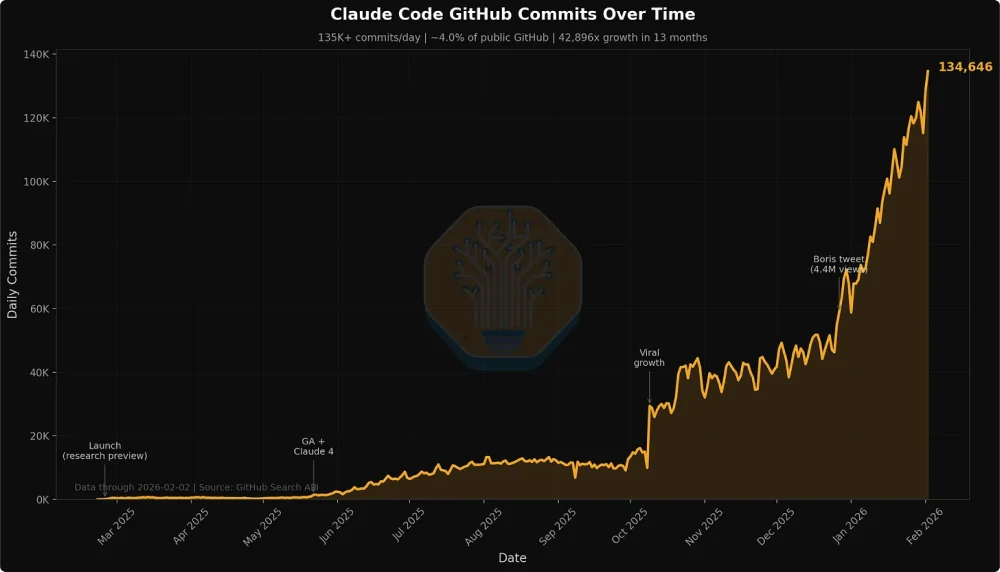
Anthropic's Claude Code, launched in February 2025 and made generally available in May, provided the commercial confirmation. By July 2025, Anthropic had recorded a 5.5x increase in Claude Code revenue. By year-end, usage had grown Tenfold since early 2025.
“AI capability is no longer the bottleneck, your delivery infrastructure is. What SWE-bench shows at the benchmark layer, we're seeing in enterprise pipelines: the model can do the work. The question is whether the pipeline is ready to supervise it.” Loreli CadapanVP Product — CloudBees
The second signal is access.
OpenClaw, created by PSPDFKit founder Peter Steinberger as a weekend project in November 2025, crossed 175,000 GitHub stars in under two weeks — one of the fastest-growing repositories in GitHub history. The [project rebranded three times in as many Months (Clawd → Moltbot → OpenClaw) before Steinberger joined OpenAI in February 2026 and transferred the project to an open-source foundation. OpenClaw gives any developer a local agent with shell execution, file system access, repository management, and pipeline integrations — configured in minutes, deployed on a laptop.
Read together, these signals don't mean every organization needs fully autonomous pipelines by next quarter. They mean the tools capable of powering Stage 3 and Stage 4 adoption are now broadly accessible and in active use across developer populations — whether the governance model governing that use is ready or not.
The Gradient, Named
Enterprise technology adoption has never been a cliff-edge, and agentic AI will not be either. What's largely missing from the current conversation is an explicit map — what the stages actually look like, and what each one demands from governance.
Stage 1 — AI suggests, human decides. Inline completions, IDE code generation. The developer reviews every line. Governance requirements: minimal; standard code review practices apply.
Stage 2 — AI drafts, human approves. AI-generated pull requests, test suites, commit messages. The human reviews output, not each execution step. Governance requirements: PR-level audit trail, attribution of AI-generated code, review policy for AI-authored changes.
Stage 3 — AI executes within a bounded scope. An agent receives a goal — "fix this failing test," "refactor this service to the new API contract" — and acts: reads files, runs shell commands, opens branches, iterates. The human sets the goal and reviews the outcome. Governance requirements: explicit scope definitions (which repos, branches, environments), approval gates on consequential actions, a tamper-evident action log.
Stage 4 — AI operates as a pipeline actor. Agents participate in full delivery workflows, deploy to staging, trigger downstream jobs, and escalate only on ambiguity. Governance requirements: full control plane, workflow-level policy enforcement, regulatory-grade auditability and provenance chain.
Most enterprise organizations are today at Stage 1–2. Fast movers are piloting Stage 2–3.
Gartner forecasts that 40% of enterprise applications will feature task-specific AI agents by end of 2026, up from less than 5% today. This data point is best read as a Stage 2→3 inflection point at scale, not a forecast of universal autonomous pipelines.
Anushree Verma, Sr. Director Analyst at Gartner, described the direction:"AI agents will evolve rapidly, progressing from task and application-specific agents to agentic ecosystems. This shift will transform enterprise applications from tools supporting individual productivity into platforms enabling seamless autonomous collaboration."
Stage 4 at scale is 12–24 months out for most organizations. The pressure is not to get there tomorrow. The pressure is to have Stage 3 governance ready before Stage 3 adoption lands — and that distinction matters because of lead time.
“Stage 3 governance lives before the agent acts, not after. The question isn’t “what did it do?”, it’s “was it ever authorized to do that?” Without that clarity, the real failure isn’t just a security incident, it’s auditability gap you can’t easily close retroactively.” Loreli CadapanVP Product — CloudBees
The Lead Time Problem Is Where the Urgency Actually Lives
Stage 3 governance — scope controls, approval gates, integration with existing access management, action logging — is not architecturally complex. But it takes time to design, build, validate, and socialize across an engineering organization. In most enterprises, this spans multiple planning cycles. That timeline is now in tension with adoption curves moving faster than expected.
The OpenClaw exposure illustrates what Stage 3 adoption looks like without Stage 3 governance. Within weeks of viral adoption, researchers at SecurityScorecard identified more than 40,000 exposed instances across 28,663 unique IP addresses — with later scans placing the figure above 135,000. Of those, 63% were assessed as vulnerable.
Three high-severity CVEs were identified, including CVE-2026-25253 (CVSS 8.8), enabling remote code execution across thousands of active instances.
The root cause was not a sophisticated exploit. Authentication was disabled by default. The tool was designed for local loopback use; hundreds of thousands of users exposed it to the internet anyway. SecurityScorecard's assessment identified the structural problem: "The more centralized the access, the more damage a single compromise can cause. What looks like convenience is actually a concentration of risk."
Jeremy Turner, VP of Threat Intelligence and Research at SecurityScorecard was direct:
"There's no shortage of adversaries that want to target those exposures if they aren't already."
That quote deserves a careful read, because it cuts both ways. It is an argument for governance — and an argument against a specific kind of governance.
An architecture where agents inherit broad credentials from a central gateway, and where the gateway is both the enforcement point and the single record of what happened, reproduces the same failure mode at a different layer. Centralizing control is not the same as concentrating risk — but the distinction lives in the design. The load-bearing controls at Stage 3 are not primarily gateway-level; they are agent-level: minimal credentials scoped to the task, fail-closed defaults, and an audit trail that does not depend on the gateway remaining uncompromised to be legible.
This is exactly the failure mode CloudBees' control plane is designed to prevent - not by becoming the single point of enforcement, but by pushing scope definitions and authorization logic down to the agent level, where the blast radius is bounded by design.
The governance infrastructure that Stage 3 requires is not categorically different from what platform engineering teams already build — it's the same logic of access control, approval workflows, and audit trails, applied to a new type of actor. The principles don't change. The enforcement points do. For example, systems now need to be designed for prompt management and injection protection. A control plane designed for human-paced pipelines needs to move closer to the execution layer to hold at machine speed. CloudBees' approach is built around exactly this surface: not what the pipeline contains, but what it is authorized to do — and whether that authorization is legible after the fact.
“Just keeping a record of what an AI does isn’t enough. You need to set clear rules ahead of time so an agent knows what it’s allowed to do -- and it should follow those rules every step of the way, not just at the start. It’s like giving someone a badge to enter a building and then never checking what they do inside. Instead, you want rules in place that guide their behavior the entire time they’re inside, and not just at the front door.” Loreli CadapanVP Product — CloudBees
Prompt injection — OWASP LLM01:2025, the top-ranked risk for LLM applications — sharpens the point.
At Stage 1, a successful prompt injection returns a malicious string.At Stage 3, it issues shell commands.
The same vulnerability class carries materially different blast radius depending on where you are on the gradient.
The Operational Question
The organizations that navigate this period well will not be the ones that moved slowest or fastest. They will be the ones that implemented governance infrastructure one stage ahead of where their adoption was — so that expanding agent autonomy never outran the controls available to constrain it.
That is not a complex principle. It is, however, a hard operational discipline: treat governance as a first-class deliverable at every stage transition, not a compliance exercise appended after the fact. It means defining scope before granting execution rights. It means building the audit trail before the agent acts, not reconstructing it afterward.
The organizations that move fastest through the adoption gradient are not the ones with the loosest controls — they are the ones whose governance model was ready for the next stage before adoption demanded it. That means scope definitions built before agents are granted execution rights. Approval gates designed before the first autonomous PR hits main. Audit trails that are first-class workflow artifacts, not log-aggregation retrofits. The practical advantage CloudBees delivers: each stage transition is a configuration change, not a security program rebuild. That’s the difference between governance as infrastructure and governance as fire drill.
That is what bounded autonomy looks like as an operational model — and it is a more durable competitive advantage than any single model capability. It is also the discipline CloudBees is built to support: governance as a native property of the delivery pipeline, not a layer bolted on after the fact.
For enterprises in regulated industries or hybrid/on-prem environments, the auditability requirement for agentic AI will arrive from two directions simultaneously: internal risk and compliance frameworks that ask "who authorized this change and in what scope," and external regulatory expectations that are beginning to form around AI system accountability. The OpenClaw incidents offer a preview: when an agent with broad system access is compromised or misdirected, the forensic question is not just "what happened" but "what was the agent authorized to do, and did it stay within those bounds?"
Organizations that build provenance chains into their delivery workflows now — as a property of every agent action — will have a governance architecture ready when that question becomes mandatory, not reactive. That is a core design principle in how CloudBees approaches agentic pipeline governance.
Here’s the CloudBees diagnostic we’d put to CTO, VP engineering, platform engineering, and security leadership right now:
Which stages are we at, honestly? What does the next stage require from governance, specifically? Have we started building it before adoption demands it?
“The organizations navigating this well aren't moving slower — they're moving with governance that's already one stage ahead of their agents. By the time Stage 3 adoption hits their pipelines, the controls aren't a blocker. They're already there.” Loreli CadapanVP Product — CloudBees

