Your flag tool doesn’t know what your CI/CD pipeline just deployed, and your pipeline has no visibility into which flags are active in production. That means your team can’t see flag state and pipeline state in the same place, creating a visibility gap.
That gap creates problems across your release workflow:
- Incidents take longer to diagnose.
- Auditors can't trace a flag change back through the deployment workflow.
- Rollbacks require coordinating two tools simultaneously instead of toggling one.
All three problems cost your team time, credibility, and recovery speed because your flag tool and your pipeline were never designed to share context.
But solving them doesn’t require migrating to a new pipeline or replacing your flag tool. It requires surfacing flag management alongside the delivery pipeline you already run.
How Most Teams End Up with Two Disconnected Systems
Flag tools and CI/CD pipelines drift apart because teams adopt them independently, creating a structural gap that only becomes visible under pressure.
A platform engineering group brings in a CI/CD pipeline to automate builds, tests, and deployments. A product or development team brings in a flag tool to control feature exposure in production. But they’re selected by different teams, at different times, and with no shared data model between them.
The disconnect doesn’t cause an immediate failure, so it persists. The gap only announces itself months or years later, when an incident, a compliance review, or a cross-team release forces both systems into the same conversation and the mismatch becomes visible.
Even when teams recognize the disconnect, they rarely act on it. Feature flags deliver more value when they’re visible inside the CI/CD pipeline. But teams that recognize the gap often assume getting there requires replatforming: migrating their CI/CD tooling, replacing their flag system, or both.
The Consequences of a Disconnected Flag Tool and Pipeline
Disconnected flag and pipeline data slows incident response, weakens governance, and adds risk to every rollback and release decision. The damage compounds as deployment velocity increases.
Incidents Become Harder to Diagnose
Tracing a production issue means cross-referencing your CI/CD dashboard and your flag tool to reconstruct what changed and when.
The pipeline shows what was deployed and when. The flag tool shows what was toggled and for which users. Responders manually correlate timestamps across both systems to reconstruct the full picture, adding time and ambiguity to every post-mortem.
CI/CD pipeline can tell you whether code shipped correctly. But it can’t tell you which users were exposed to a feature or whether a flag change caused the regression. That’s why incidents take longer: The tool running your pipeline only covers half the diagnosis.
Governance Lives in Neither System Fully
Approval workflows, audit trails, and flag ownership can't span a gap the systems weren't designed to bridge. No single system captures the full chain:
- Who approved the flag
- Who triggered the deployment
- The intended exposure
- Whether the rollout matched the plan
Teams fill the gap with spreadsheets, Slack threads, and manual checklists. That works until you’re deploying daily across multiple teams and maintaining hundreds of flags.
And when audit season hits, those workarounds don’t hold up. Auditors want infrastructure-level proof of control. Without it, you’re looking at failed audits, compliance findings, and weeks of remediation work. Passing those audits means capturing the full approval chain in one place, not stitching it together across two tools after the fact.
Rollback Coordination Adds Risk
Rolling back cleanly requires coordinating a deploy revert and a flag toggle across two interfaces at the same time. Under incident pressure, that coordination breaks down. The flag stays on while the deploy rolls back. Or the deploy reverts, but the flag state has already changed, so the rollback doesn’t fully resolve the issue.
What should have been a quick kill switch becomes a multi-step coordination exercise that turns a recoverable incident into a prolonged outage, with extended customer impact, potential SLA breaches, and on-call escalation.
Rolling back a single feature without redeploying requires flag control inside the pipeline.
Release Decisions Lose Context
A release manager approves a rollout without knowing which flags are already active in that environment. Meanwhile, an engineer toggles a flag without seeing what’s queued in the deployment pipeline.
The missing piece in most CI/CD systems is feature-level visibility into what's live and who’s exposed. Without it, conflicting changes reach production, features go live before they’re ready, or a rollout collides with an active flag and causes a customer-facing regression.
That gap is manageable at low velocity. At five deployments per day across multiple teams, that partial information turns into production conflicts.
Signs the Gap Is Showing Up in Your Pipeline
If any of these sound familiar, the gap is already costing your team time during incidents, credibility during audits, and speed during rollbacks.
A Production Incident Required Checking Two Systems to Diagnose
Your last production incident required switching between your CI/CD dashboard and your flag tool to determine root cause. That context-switching slowed your mean time to resolution. A single view of flag state and deploy state inside the pipeline would have answered the question immediately—without your team correlating timestamps across two tools mid-incident.
Flag Changes Have No Clear Approval Trail
If proving who approved a flag change and when requires digging through a separate tool, your team has no clear approval trail.
During a compliance review, that gap forces manual reconstruction: pulling records from two systems to prove who changed what and why. A single record inside the pipeline that connects the flag change to its deployment, approval, and owner eliminates that scramble.
Rollback Required Coordinating Across Tools Under Pressure
Rollbacks take longer than they should because reverting a release means two engineers working two tools in parallel.
One reverts the deploy while the other toggles a flag. If either one moves too early, too late, or out of order, the rollback fails or only partially resolves the issue. Meanwhile, customers stay exposed to the broken feature, SLA clocks keep running, and on-call engineers escalate what should have been a quick fix.
What Closing the Gap Looks Like in Practice
Closing the gap doesn’t involve migrating to a new pipeline or replacing your flag tool. It means embedding flag visibility into the workflow teams already use, so flag state and deploy state are visible in the same place.
Adding release control to your pipeline starts with integrating flag management into your existing CI/CD workflow, so flag state and deploy state are visible in the same place. Once they are, teams operate faster and with less risk: Incident responders, auditors, and release managers all work from one source of truth instead of reconstructing context across two tools.
CloudBees Feature Management integrates release control directly into the pipeline—not as a sidebar dashboard, but as part of the same workflow where code ships. Engineering teams get progressive rollout to limit blast radius, an instant kill switch for faster recovery, and a governed flag lifecycle that keeps auditors satisfied.
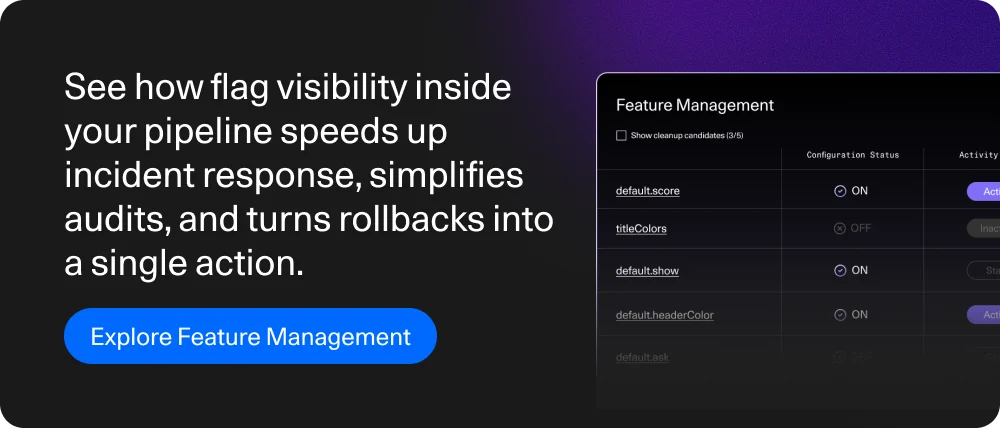
See how flag visibility inside your pipeline speeds up incident response, simplifies audits, and turns rollbacks into a single action.