Every day, engineers leave their delivery platform to find answers.
They open documentation, search through logs, file support tickets, or ask a teammate how a pipeline stage was configured. None of that shows up on a dashboard, but it adds up, slower onboarding, longer triage cycles, and decisions made with incomplete information.
AI promised to fix this. But most AI arrives without understanding the system it’s meant to support.
Without visibility across pipelines, policies, and tooling, AI falls back to partial signals. That’s when you get confident but incorrect answers, or recommendations that don’t hold up in your environment. AI can reduce the friction in software delivery, but only when it understands the environment it’s working in. Without that, it doesn’t remove risk. It shifts it, and in some cases, even magnifies it.
In a regulated environment, a wrong action becomes an audit finding. In a production pipeline, a hallucinated fix can turn into an outage or a breach.
AI assistants are everywhere. The real key to unlocking AI productivity gains in the SDLC isn't the assistant — it's the context the assistant runs on. AI doesn’t reduce friction unless it understands your environment. And until now, it hasn’t.
You need AI that understands your complex environment before it touches it. That’s why we built an AI assistant directly into CloudBees Unify.
Embedded AI for DevOps: Guidance Without Leaving Your Workflow
The CloudBees Unify AI Assistant provides in-context guidance, embedded directly in the platform where your teams already work. You ask a question in plain language and get a specific answer based on your environment, without leaving your screen. No frustrating tab switching, no copying and pasting logs into a separate chatbot. And because it’s operating within CloudBees Unify, it already understands your:
- Pipeline state and history
- Policies and guardrails
- Delivery records and system health.
So instead of generic answers, you get tailored responses tied to your system’s current state.
This first generation of the CloudBees Unify AI assistant is designed to assist, not act. It helps you understand what’s happening and what to do next, grounded in the reality of your pipelines, your policies, and your delivery history, without the added risk of autonomous actions.
CloudBees Unify: From SDLC Control Plane to AI Context Plane
CloudBees Unify was designed to bring order to a fragmented SDLC.
It acts as a control plane across your existing tools, giving you unified visibility, continuous policy enforcement, and a consistent way to manage delivery without replacing your stack.
Your pipelines, your tools, your way.
But visibility alone isn’t enough for AI.
Most AI tools operate on partial information, logs without history, code without pipeline context, answers without awareness of policy. That’s where things break down. You get responses that sound plausible but miss the constraints that actually matter, what changed, what’s allowed, what’s already been tried, what’s at risk.
We’ve already seen how this plays out in practice. In a recent case, an airline chatbot provided a refund policy that didn’t actually exist, and the company was required to honor it after a customer relied on that guidance.
The response looked credible, but it wasn’t grounded in the system it was representing.
That’s the risk of AI without the right context at the right time.
In the SDLC, those gaps show up as misdiagnosed failures, unsafe recommendations, or actions that conflict with policy. Not because the AI is incapable, but because it doesn’t have a complete view of the system.
When CloudBees Unify brings together pipeline data, policy definitions, delivery history, and system state into a single layer, that control plane becomes a context plane, one that reflects how your system actually operates end to end.
That’s what effective AI depends on.
With that foundation, AI can explain issues based on real changes, guide actions within policy boundaries, and connect signals across tools into a single, coherent answer, delivered where and when it’s needed. Today, the assistant provides guidance and recommendations, with the context, guardrails, and auditability in place to support more autonomous, compliant actions over time.
Real-World Use Cases
Getting oriented, fast
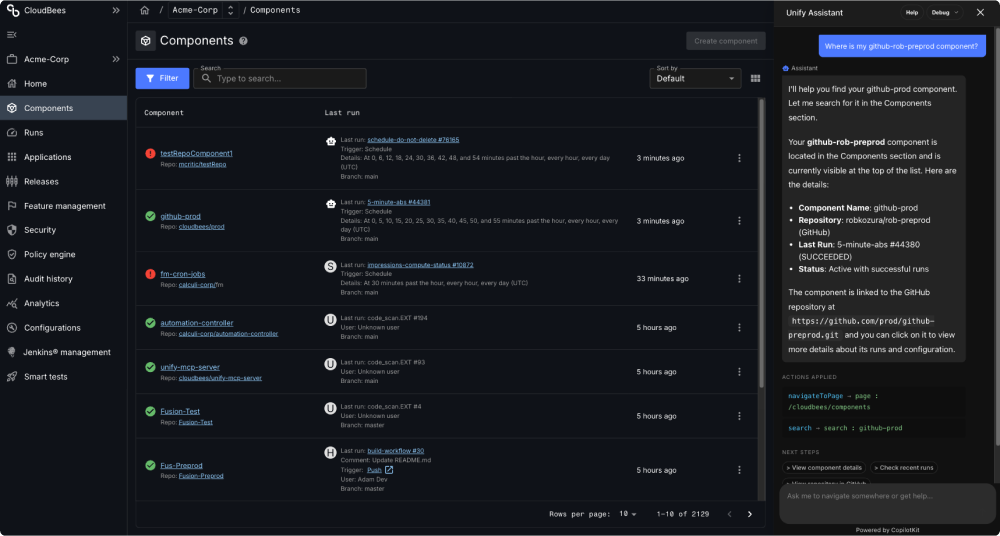
New to a system? Instead of tracking down a teammate or digging through documentation, just ask:
“Where is my X component?”
The assistant guides you straight to your pipeline.
Cleaning up feature flags
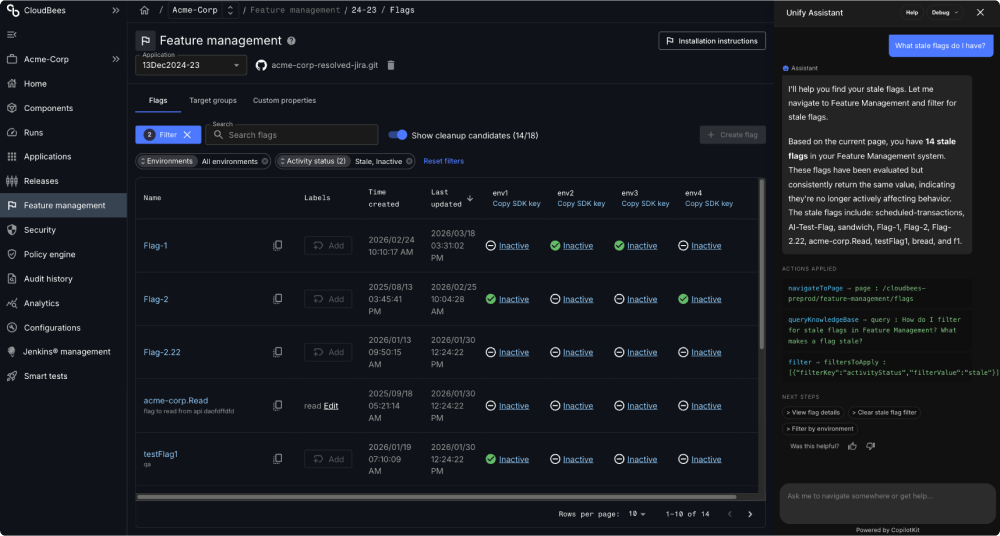
Feature flags tend to accumulate over time. The assistant can surface stale flags, explain where they’re used, and take you directly to the right place to clean them up, reducing risk and overhead.
Ask: “What stale flags do I have?”
Debugging a failed build
When a build fails, the first step is understanding why. Instead of jumping between tools and parsing logs, ask:
“Why did this build fail?”
The assistant uses pipeline history and recent changes to point you in the right direction, cutting down investigation time.
Integration over Migration: The Path to a Modern, Agentic SDLC
Most AI tools are destinations. You leave your workflow, add context manually, and hope for a useful answer.
The CloudBees Unify AI Assistant is embedded directly in the workflow, with access to the same data you’re already working with. It operates within your policies, and every interaction is logged, which is critical in real delivery environments.
At the same time, AI is becoming a default feature inside individual platforms, often tied to a single vendor’s ecosystem. That model only works if your entire delivery chain lives in one place.
Most don’t.
CloudBees Unify operates across your existing toolchain, so you don’t need to migrate to adopt AI. You get value on top of what you already run. In the CloudBees DevOps Migration Index (2025), 92% of enterprise IT and DevOps leaders reported greater delivery efficiency by integrating tools rather than replacing them.
- No migration required, works with your infrastructure as it exists today
- No vendor lock-in, spans your full delivery chain
- AI that operates across systems, not just within one tool
CloudBees Unify AI Assistant is Available to Customers Now (Beta)
CloudBees Unify connected your toolchain through a single control plane. Now, it becomes the context plane for AI, laying the foundation to supercharge your SDLC with intelligence grounded in your real delivery environment.
The CloudBees Unify AI Assistant is now available to existing CloudBees Unify customers. This initial release focuses on helping users navigate Unify and complete tasks more efficiently. From there, it expands into planning, triage, and execution across the SDLC.