Your AI agent can write code. But is it safe to ship?
Build passed. Zero criticals. Ticket closed. Three green checkmarks on a release that would have paged someone at 3am.
AI coding agents are brilliant, but they lack the context to know whether the code they produce is actually safe to ship into production. The DevOps Agent Kit is the open-source way any agent you're running plugs into it. Apache 2.0, on GitHub today. In this post we share: why we built it, how it works, and how to start using it this afternoon.
AI Coding Agents Will Double Your Commit Volume. Is Your DevOps Stack Ready?
AI coding agents are going to double your commit volume by the end of the year. This revolution is real, it is accelerating, and it is not going backward. In the time it takes to reheat a cold coffee, an AI coding agent can scaffold a new service, write the tests, fix its own bugs, open a pull request, and draft release notes that are frankly better than what most of us bother to write. And we’re still at the early stage of the curve.
Your delivery infrastructure was built for a world where humans typed every line. However, great developers know that shipping software was never just about writing code. It’s about understanding the system that code is flowing through. Every tool in your stack is telling you what it sees about its own slice. GitHub sees GitHub. Your scanner sees your scanner. Jira sees Jira. But in complex systems like the enterprise SDLC, catastrophic failures occur when small, apparently innocuous failures join to create opportunity for a systemic accident (How Complex Systems Fail, Richard Cook).
“So… are we good to ship?”
Today, that simple question triggers a 40-minute scavenger hunt across six tabs. You open one CI system. Then another. Then your scanner. Then Jira. Then a Slack channel with 400 unread messages that you have been avoiding. Then a dashboard that sort of works if you squint and ignore the parts that don’t load. Eventually you have a guess, and the guess is what you tell the room. The industry’s solution to this visibility challenge has been to go all in on a homogenous platform to pull everything together in one place, which almost never works in practice.
With the volume of AI-generated code and number of commits growing, is your stack ready for what's coming next? That’s the question dominating boardroom discussions at every company that ships software.
Shipping safely means understanding how those pieces come together. It’s seeing how a failed pipeline, a lingering security finding, and a misconfigured feature flag combine into risk, not just that each exists in isolation. It means knowing where to look for trouble, what’s actually blocking the release, and who needs a heads-up before the all-hands email goes out.
The magic question: “Are we good to ship?”
Imagine you are sitting in your IDE on a Friday afternoon, and instead of writing a function, you ask your agent the one question that actually matters:
"Are we good to ship?"
With CloudBees Unify, your agent has the answer. Not a guess, or a hallucination, but an actual verifiable answer. It checked every CI run across every tool you own, cross-referenced your open security findings against your release criteria, verified your flag state, confirmed the rollback is tested, told you which component is blocking the train, and gave you a clean go or no-go, with receipts, in the same window where you write code.
Here’s what it looks like:
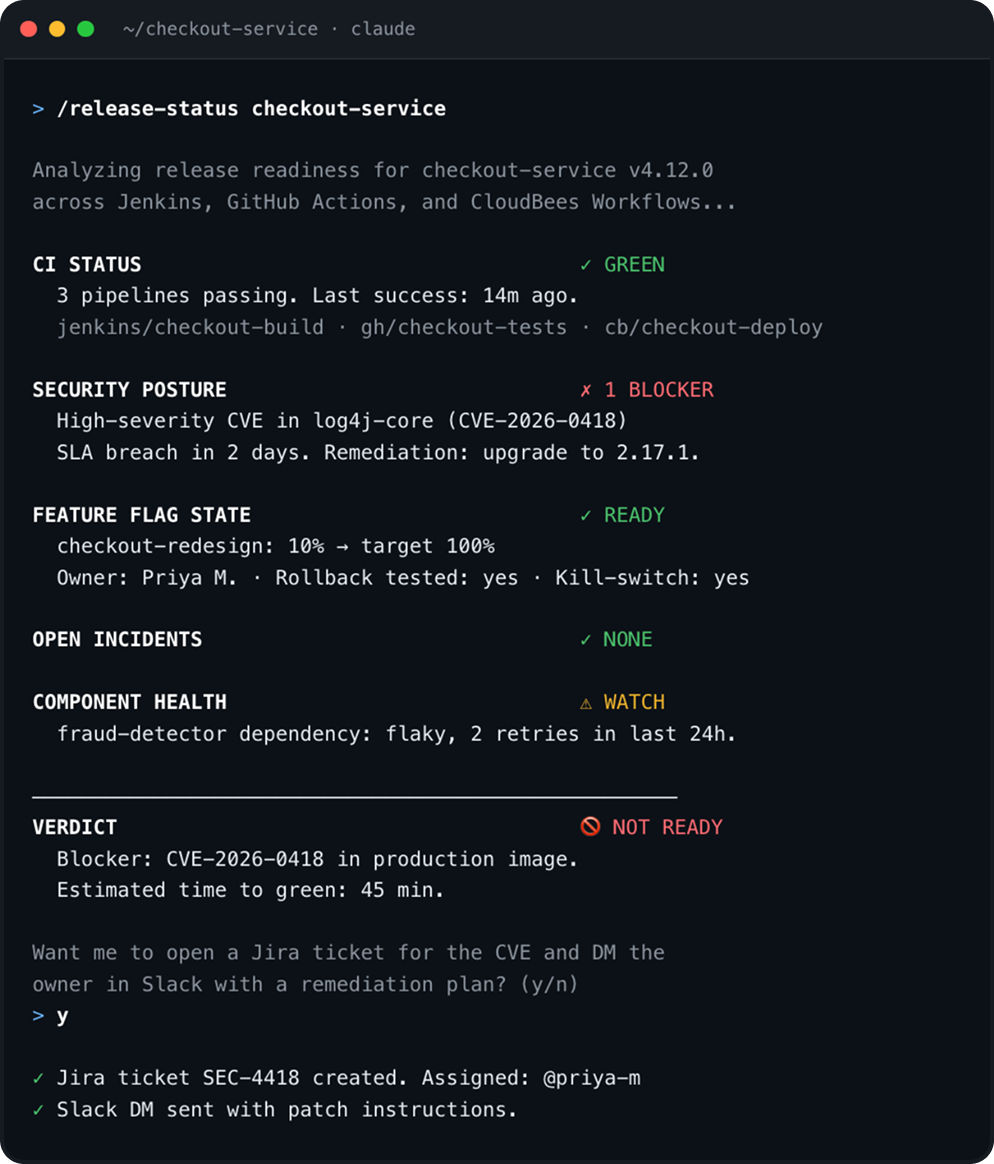
One command. Four systems. A real answer. No more tab dance on a Friday afternoon.
Introducing the DevOps Agent Kit
Today we are open-sourcing the DevOps Agent Kit. Apache 2.0. Live on GitHub starting now. You can clone it, export your tokens, run Claude from the directory, and you have an agent that can see across your CI, your security scans, your release workflows, and your feature flags in a single conversation.
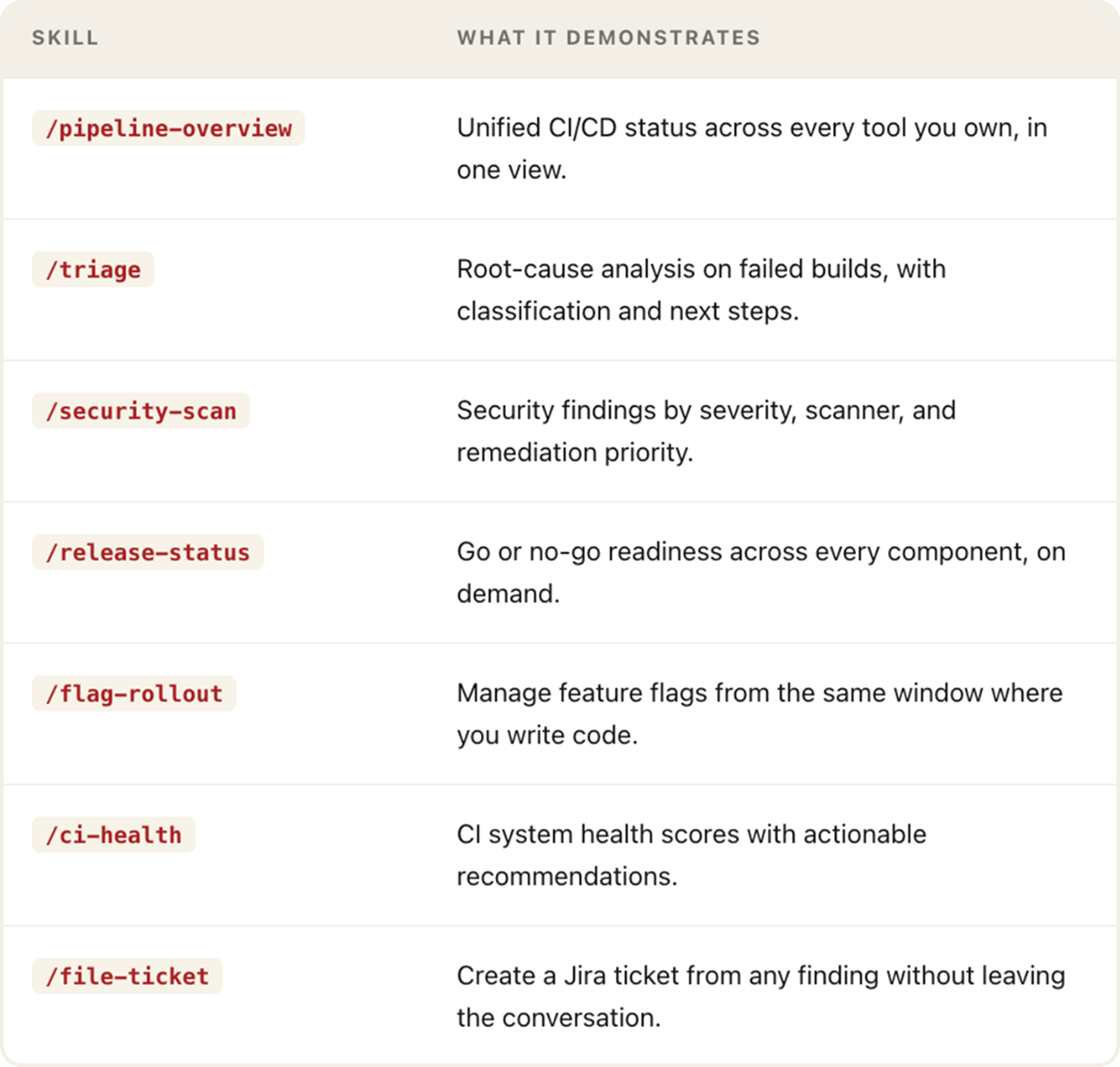
Let us be clear about what this is and what it is not. The kit is not a standalone product. It is not a finished solution. It is scaffolding. A working starter template that shows one specific thing: how to plug an AI coding assistant into your SDLC and enable it with context from across the entire heterogeneous stack. The kit ships with seven example skills, each one demonstrating a different pattern for agentic DevOps work.
Fork them. Edit them. Rip them apart. Build your own.
The kit ships read-only by default. Every write action requires an explicit human confirmation, every time, no exceptions. RBAC, audit trails, and policy all live at the platform layer, which means any agent you build inherits the exact same governance a human operator does. Nothing more, nothing less. When you fork the kit and build your own skills on top of it, those guardrails come along for the ride automatically, you don’t have to rebuild them every time.
The Context Plane for Agentic DevOps
An agent is only as good as the data it can access. This one has access to 63 tools across your entire DevOps stack because it is built on CloudBees Unify.
CloudBees Unify is the control and context plane for the agentic era. It creates a universal data model that normalizes pipelines, runs, security findings, analytics, workflows, and release states across every CI/CD tool your organization already runs. Jenkins. GitHub Actions. CloudBees workflows. Anything else you have in production that matters.
Unify sits as an operating layer across your existing stack, so there’s no need to rip and replace your existing systems. You connect the tools you already use, and Unify integrates them into a single system, creating unified visibility, consistent policy enforcement, and auditable automation across your SDLC.
By consolidating pipeline data, policy definitions, delivery history, and system state into that layer, Unify turns your delivery system into a control plane, and, critically, a context plane. Any agent you connect inherits a complete, system-wide understanding of how software moves from commit to production.
If you’re not already a CloudBees Unify customer, you can create a free account and start using your DevOps agent from Claude Code or Cursor to see governed agentic delivery in action today. For more details on how to use the kit, check out our How-to Guide.