

A broken release in financial services can trigger compliance reviews, damage customer trust, and force hours-long rollbacks that pull engineers off critical work.
To avoid that risk, many financial service teams slow down.
They extend QA cycles, add approval layers, and limit how often they ship. But fewer releases lead to larger, riskier changes, and when something breaks, it’s harder to pinpoint the issue because more changes are bundled together.
Rollback isn’t simple, either. Teams can’t just “turn off” a feature. They have to build a hotfix, package a new version, and push it through the full pipeline while the issue remains live. That recovery takes hours.
Feature flags change that by decoupling deployment from release, so teams can ship code without exposing it immediately. Code ships to production on its own schedule, while flags control when customers see new features, who sees them, and how many see them at any given time. If something fails, a flag lets teams remove the broken feature from production without redeploying.
That need is intensifying. Financial services teams are shipping more code, and more of it is now written with AI assistance, into the same regulated environment. More change moving faster means more to track and more an auditor can ask about. The faster a team ships, the more the system around its flags has to carry.
Many financial services teams already use some form of feature flags for this reason. The question is whether the system they’ve built can keep up as the organization scales.
What breaks when financial services teams outgrow their homegrown flags
In homegrown flag systems, engineers build toggles into a config file or database because they need some way to control what runs in production. For one team with a handful of flags, that works.
But it stops working as the organization grows. More teams adopt flags, and their count climbs into the hundreds. At that point, basic gaps become operational risks that are hard to ignore:
- No visibility into which flags are live across environments
- No log of who changed a flag or when
- No approval step before changes reach production
- No way to target features to specific user segments without custom code
Every time a product manager or business stakeholder needs a flag changed, they file a ticket and wait for an engineer to do it manually.
Homegrown flag systems start as lightweight internal tools and quietly become cumbersome products nobody is directly responsible for maintaining. There’s no flag lifecycle management, so stale flags accumulate, nobody owns cleanup, and the engineering hours spent on upkeep grow with every team that adopts the system.
In financial services, those gaps carry regulatory weight. Without audit logs or approval workflows, there’s no way to show an auditor who made a change, when it happened, or whether it was authorized. That’s a compliance exposure that grows more expensive with every audit cycle.
A dedicated feature management system replaces these fragmented tools by putting every flag across every environment in one place, with built-in audit logging, approval workflows, targeting rules, and governed self-service so product and business teams can control feature exposure within guardrails that engineers define. CloudBees Feature Management does this while integrating directly into the CI/CD pipeline teams already run.
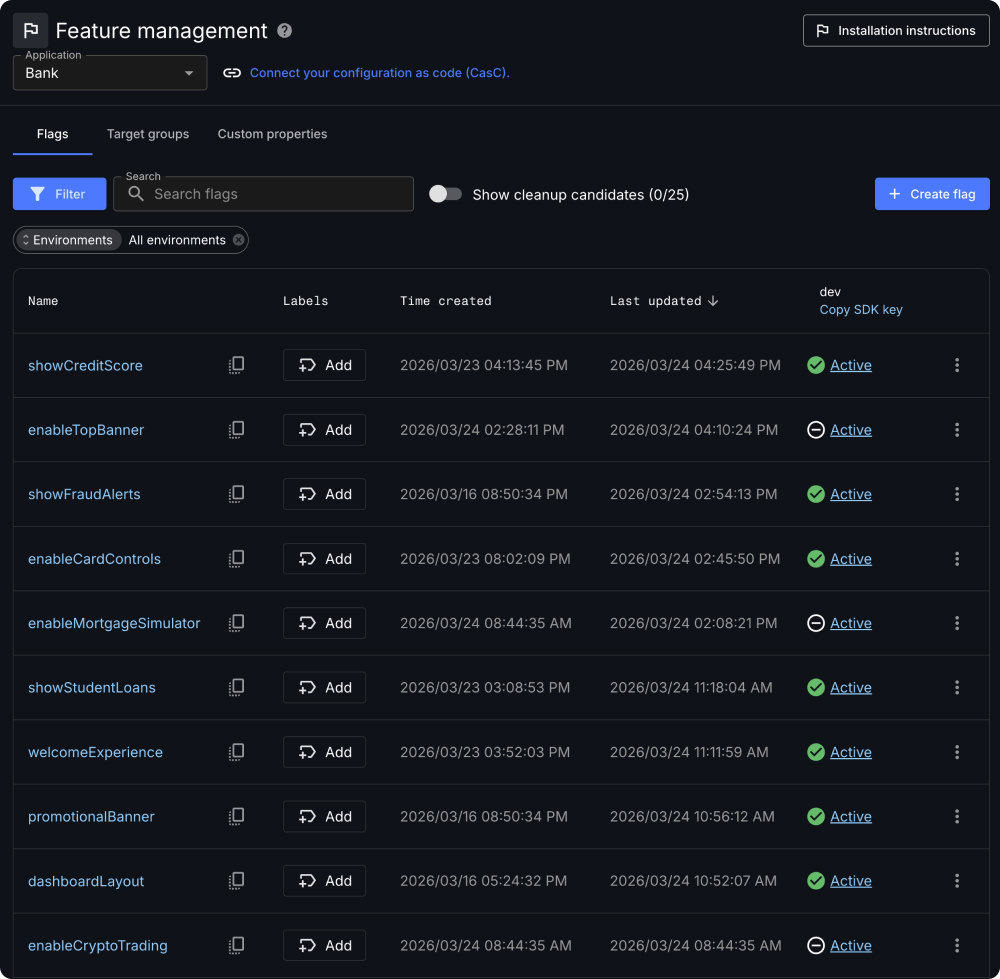
This visibility is the foundation. Here are four ways teams are using CloudBees Feature Management to make releases faster, safer, and auditable.
Containing release risk
When a feature breaks in production, the engineering team faces a recovery process that exposes customers to errors for as long as the fix takes to ship.
Traditional rollback requires building a hotfix, repackaging the application, retesting it, and redeploying, a cycle that can stretch for hours while the broken feature stays live.
The cost of slow rollbacks in financial services
Every hour a broken feature stays in production, the consequences grow. Customers encounter errors. Support tickets rise. Compliance teams begin documenting the incident. Engineering leadership has to explain to organizational leadership why recovery is slow.
Engineering teams at financial services organizations face this cycle constantly. They request hotfixes from developers, create a new version, and push it through the full pipeline while business stakeholders wait. That pressure pushes teams toward larger, less frequent deployments.
But larger releases bundle more changes together, which means more potential failure points and longer recovery when something does break.
How kill switch enables instant containment
CloudBees Feature Management wraps features in flags. The kill switch capability lets teams turn a flag off instantly, with one toggle, when something breaks.
The code stays in production, but the issue disappears from the user experience—no rebuild, redeploy, or change window required.
The customer-facing impact drops from hours to seconds.
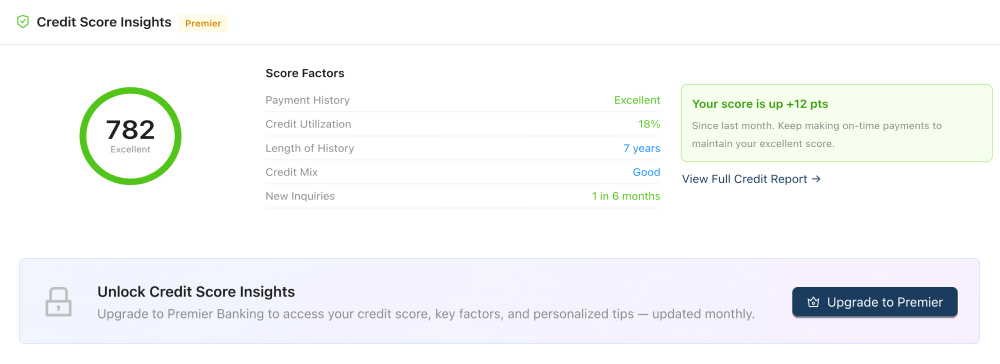
Financial services teams evaluating CloudBees Feature Management consistently point to kill switch as the most valuable capability for reducing rollback time.
The ability to return to a safe state without affecting users changes how teams approach risk. When rollback takes hours, teams deploy less often. Once rollback takes seconds, teams deploy more frequently with smaller changes because the cost of getting something wrong drops dramatically.
Testing experiences before committing to them
Financial services organizations serve a broad customer base—from retail clients to wealth management accounts to mortgage holders—and each segment relies on tailored experiences. When a new feature launches, there are two problems.
First, there’s no way to test whether a different version would perform better before committing to one. Second, there’s no way to show different features to different customer segments without maintaining separate code paths, so a student client and a wealth management client see identical functionality.
The cost of shipping features blind
If a different layout would convert better, or if a specific customer segment needs a different experience entirely, the team has no way to find out without shipping one version to everyone and waiting for the data to tell them whether it worked.
Without feature flags, there’s no way to differentiate by segment without maintaining separate code paths, so a student account and a wealth management client see identical functionality. If the experience underperforms for a specific segment, the team only finds out after the entire customer base has been exposed, and the only way to change course is a new deployment.
How A/B testing and per-profile targeting reduce exposure risk
To help financial services teams avoid the risk, CloudBees Feature Management enables controlled exposure through A/B testing and per-profile targeting.
A/B testing lets teams split traffic between two or more variations of a feature for a specific customer segment. They can measure which variation performs better with real user data before rolling it out to everyone.
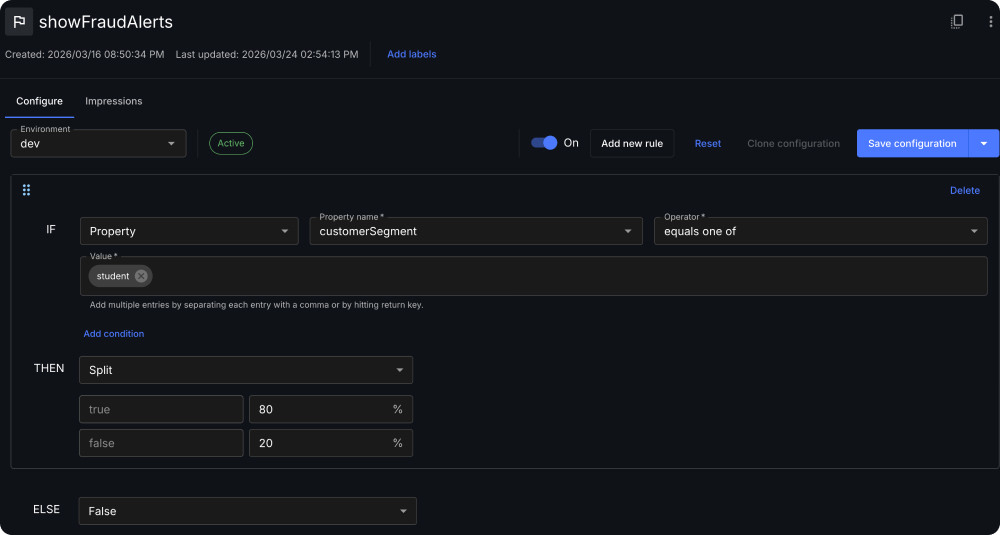
Per-profile targeting gives teams granular control over which features each customer segment sees based on properties like account type, profile tier, or product eligibility.
For example, a student client doesn’t have access to crypto trading or the mortgage simulator, while a mortgage customer sees refinancing banners and rate comparisons, and a wealth management client gets credit score insights and premium card options.
Teams can also use feature flags to provide an experience tailored to different devices. The same user sees different features depending on whether they’re on mobile or web, controlled by target group rules in the flag configuration. Changing any of these rules requires a flag update, not a code change or a new deployment.

This level of control is a key driver for adoption among financial services teams, where segmenting customers by profile type and tailoring their experience without code changes is a core requirement.
CloudBees Feature Management gives them the flexibility to test new business models and product offerings on a per-segment basis, without exposing the entire customer base to unnecessary risk. The number of those changes only grows, and as more of that code is AI-assisted, proving a human authorized each change becomes its own requirement.
Proving control to auditors
Financial services regulators require clear evidence of who changed what, when, and whether it was authorized. Few engineering teams have this built into their feature release process, so when an auditor asks, they reconstruct it manually across multiple systems.
The cost of reconstructing Compliance after the fact
When an audit request comes in, teams pull logs from version control, cross-reference deployment records, and piece together a timeline across multiple systems. That process is slow and error-prone and often reveals gaps in the record that are difficult to explain under regulatory scrutiny.
The problem gets worse as organizations scale because more people changing more flags across more environments (development, staging, production) means more gaps in the record. By the time an audit happens, the people who made those changes may not remember the context—or may have left the organization altogether.
Any change that can’t be traced or explained becomes a compliance issue, and as teams deploy more frequently, the number of those changes only grows. Without a required approval step, flag changes reach production based on whoever has access, with no record of whether the change was authorized.
How audit trails and approval workflows enable built-in governance
The audit trail in CloudBees Feature Management logs every flag change automatically, capturing who made the change, when, what the previous state was, and which environment was affected. The record is queryable, filterable by application and date range, and exportable.
So when an auditor asks, “Who changed this and when?” the answer is already there, without pulling engineers off their day-to-day work to reconstruct it.
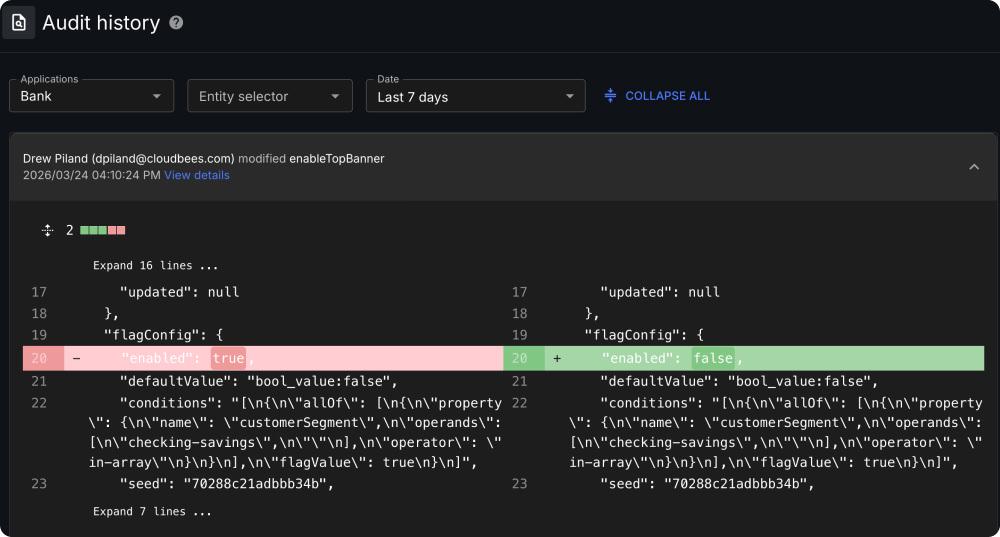
Approval workflows add a preventive layer. Before any flag change reaches production, it goes through a sign-off process: a business manager receives an email notification, reviews the requested change, and approves or rejects it. Role-based access controls determine who can request changes and who can approve them, so a developer can’t change the customer experience without the appropriate business-level sign-off.
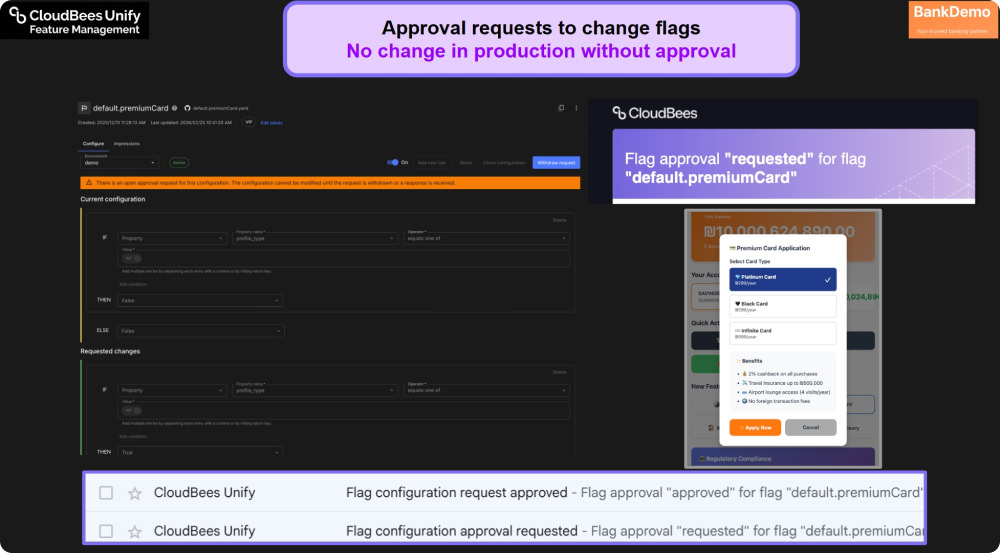
Governance becomes part of the release process itself, so compliance evidence exists as a byproduct of using the tool rather than extra work someone has to do after the fact.
Rolling out changes safely at scale
Even after a team has decided which feature to ship and validated it with a subset of users, releasing it to the full customer base is still binary: everyone gets it, or no one does.
Ideally, teams would use progressive rollout to gradually increase the percentage of users who see a new feature, starting small and expanding only after confirming it works as intended at each stage. Without that ability, if the feature has a performance issue or an edge-case bug that only surfaces at scale, every user is affected simultaneously.
The cost of all-or-nothing deployments
When every user gets a release at the same time, teams lose the ability to catch issues early. A bug that would have surfaced with 5% of users exposed instead hits every customer in production.
Consider a financial services app rolling out a new fraud alert feature. Without progressive rollout, every customer sees the new alerts on the same day. If the alerts trigger false positives for a specific transaction type, every customer is affected. Support volume spikes, trust erodes across the entire customer base, and the team scrambles to redeploy.
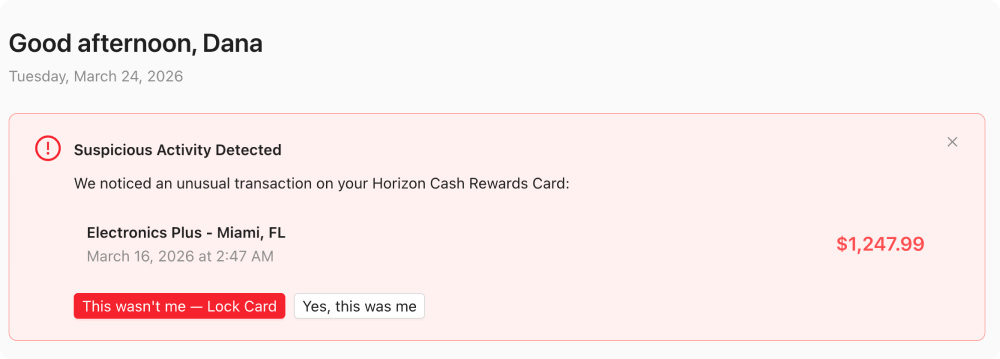
Teams compensate by adding manual coordination, extending testing cycles, and reducing deployment frequency. Each of those measures slows delivery. And the slower the delivery cycle, the larger each release becomes, which increases the risk profile of every deployment.
How progressive rollout enables staged releases
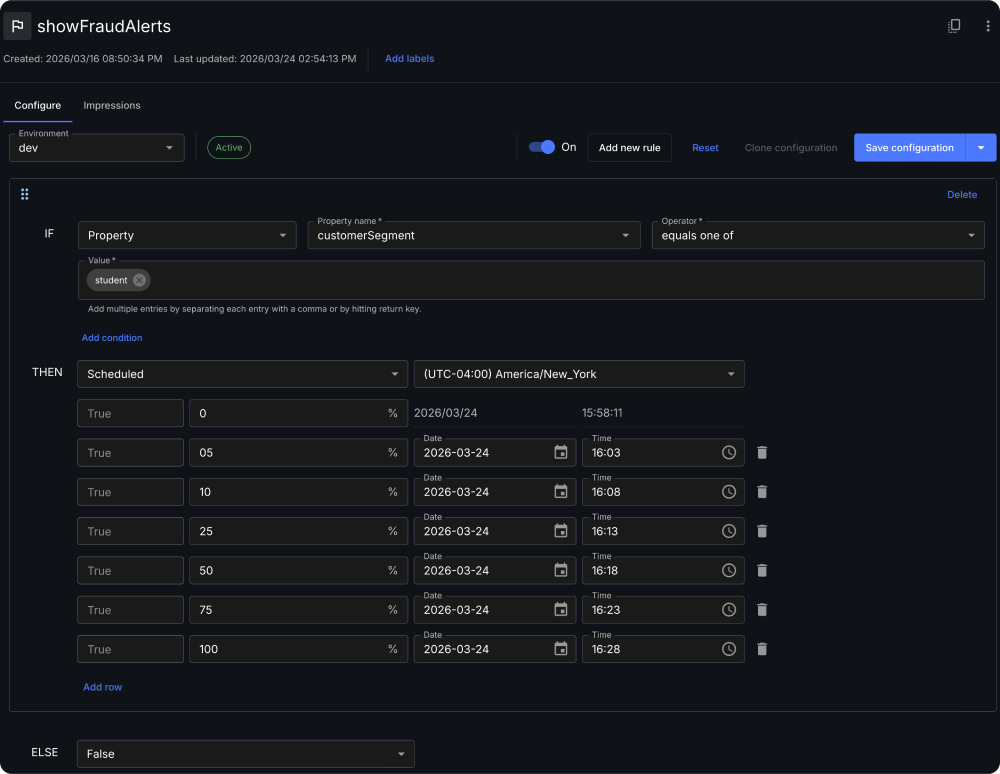
Progressive rollout in CloudBees Feature Management lets teams ramp exposure from 0% to 100% on a defined schedule while monitoring error rates and performance at each step. If metrics degrade, the team can pause the rollout or roll back instantly, and only the exposed percentage is affected.
Managing flags inside the delivery pipeline
In most release workflows, flag changes and deployments happen in separate systems. Engineers deploy code through the CI/CD pipeline, then switch to a different tool to activate or deactivate flags.
The cost of managing flags outside the pipeline
That manual handoff adds steps and introduces risk during high-pressure moments like incident response or coordinated releases. A flag might be toggled on before the deployment is complete, or a deployment might go out while a flag is still configured for a previous version.
Coordinating between the two systems requires manual checks, and under pressure, those checks get skipped.
How CI/CD integration and configuration as code connect them
CloudBees Feature Management uses CI/CD integration to embed flag activation directly into the pipeline as automated steps. Flags turn on at specific stages (development, staging, production) as part of the pipeline workflow, so the release process doesn’t require a separate tool or a manual handoff between teams.
Configuration as code (CasC) makes this scalable by managing flag configurations in Git with bidirectional sync to the management UI. When a team builds a complex flag configuration for one application, they can deploy that same structure across multiple applications without rebuilding it.
Because CloudBees Feature Management embeds flag management directly in the delivery pipeline, teams see flag state and deployment state in the same place and manage both from one system.
Bringing feature flags into your release process
Financial services teams don’t have to slow down releases to stay safe. They have to separate deployment from exposure—and that’s what feature flags do.
Every use case above addresses the same underlying problem for engineering leaders in financial services: deployment and exposure are coupled, and that coupling forces a choice between speed and safety.
CloudBees Feature Management gives financial services teams four ways to close that gap:
- Kill switch provides instant containment when something breaks.
- A/B testing and per-profile targeting let teams validate changes with real users before full exposure.
- Audit trails and approval workflows embed governance into the release process itself.
- Progressive rollout with CI/CD integration automates staged releases across the pipeline.
That system sits between the delivery pipeline and the customer, giving financial services teams control over what gets released, to whom, and when, without requiring a separate tool outside their existing CI/CD workflow.
Explore the full set of capabilities of CloudBees Feature Management to see how it works in your pipeline, or book a demo to walk through the product with your own use cases.

