
For years, microservices were sold as the answer to slow, painful releases. Break the monolith, the logic went, and every team could move at its own pace. Pipelines would multiply. Deployments would accelerate. Velocity would soar.
And for a while, it seemed true.
Teams shipped changes constantly. Services deployed independently. Autonomy increased.
But beneath that speed, another trend emerged—one few organizations anticipated:
Releases became harder, not easier.
The more distributed systems became, the more fragile the release process grew. What used to be a single, predictable event turned into a puzzle of drifting environments, mismatched versions, and regressions that appeared out of nowhere.
Eventually, almost every organization discovers the same truth:
The problem isn’t how you built the architecture. It’s how you release it.
Independent Deployments Look Fast—Until They Don’t
On paper, deploying individual components makes perfect sense. Each team controls its own pipeline. One service can deploy today, another tomorrow. No coordination needed.
In reality, microservices depend on:
- shared data models
- implicit contracts and behaviors
- version assumptions about other components
These are rarely captured in CI/CD, so when services deploy independently, the interactions surface elsewhere, usually late in the release cycle or in production.
Here’s how it typically plays out:
A change to Service A breaks Service C. Test environments drift over a weekend. Staging behaves differently from QA. A “simple” deploy triggers a Slack investigation across multiple teams.
No one is quite sure:
- Which versions are running together
- Whether this exact combination was ever tested
- What the system’s last stable state actually was
Deploying components independently optimizes for local speed—and unintentionally degrades system reliability. MTTR increases. Senior engineers spend more time debugging release problems and less time delivering new value.
Environment Drift: The Silent Release Killer
Microservice environments drift almost immediately:
- QA tested Service A v3 + Service B v7
- Staging validated Service A v4 + Service B v6
- Production is running Service A v2 + Service B v6
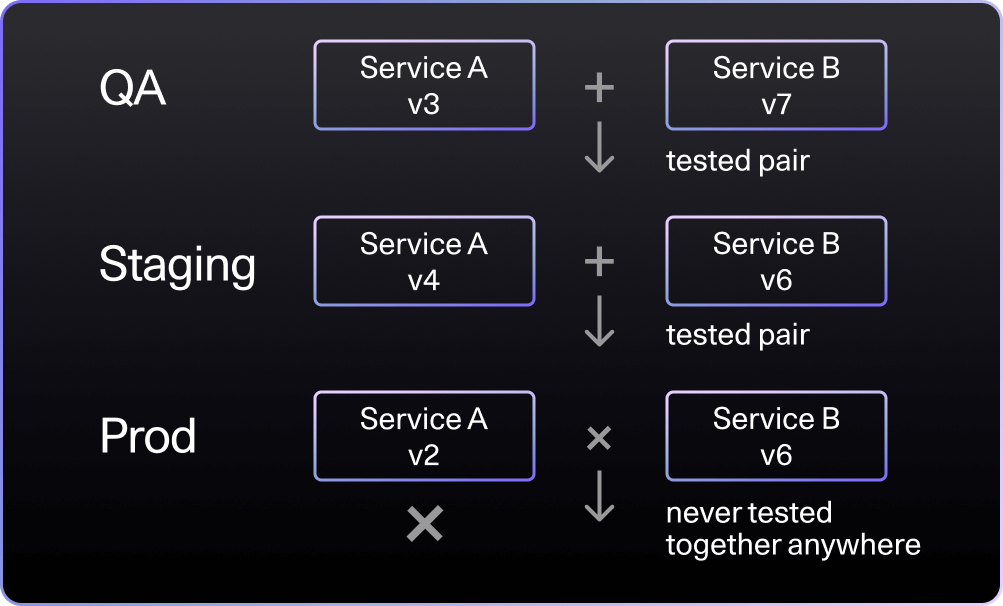
Teams test against combinations that never reach production. Production receives combinations no one has ever tested.
Drift doesn’t just create bugs. It erodes trust.
Once environments diverge, testing becomes guesswork, and releases become nerve-wracking. Drift is also one of the largest contributors to escaped defects—issues that slip through testing and cause outages, customer-impacting incidents, or compliance exposure.
Rollback Should Be a Button—Not an Investigation
Rollback is supposed to be simple: restore the last known good version.
But when your “release” is actually 32 independent deployments drifting at their own pace, there is no last known good version, only dozens of possible system states.
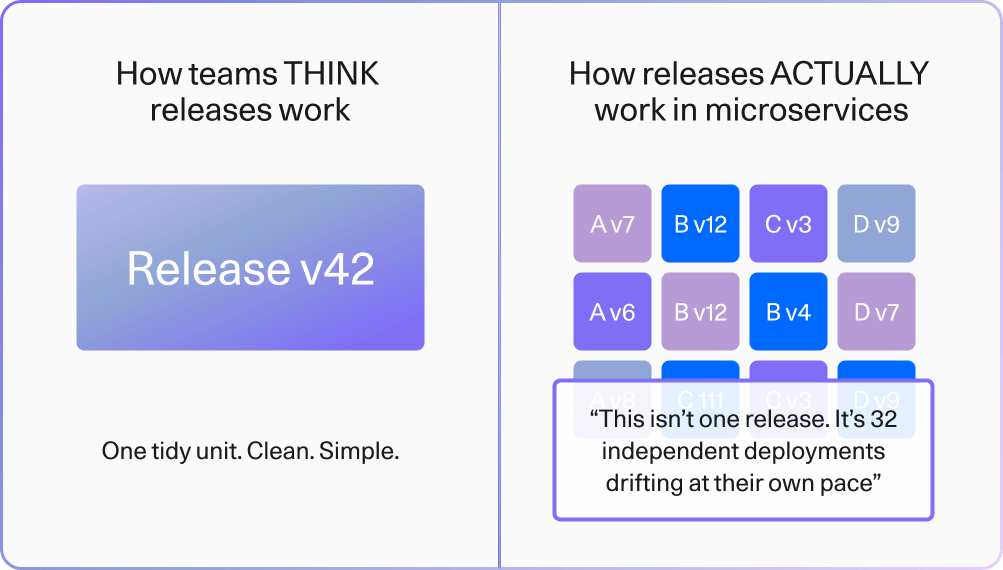
Teams must first figure out:
- Which services changed?
- Which were expected to change?
- Which ones introduced new behavior?
- What was the last safe combination?
This isn’t a rollback. It’s reverse-engineering your own system under pressure.
And as your system grows, so does the complexity of unraveling it.
Your System Behaves Like an Application—So Release It Like One
Here’s the paradox: microservices may run independently, but your customers experience the system as a whole.
They don’t care which service changed. They care whether the application works.
So the real question becomes:
If the system behaves like an application, why release it as a set of scattered components?
Releasing as an application doesn’t reduce team autonomy. It simply aligns releases with reality:
- Some services are interdependent.
- Some versions need to be validated together.
- Some behaviors break if promoted alone.
Application-level releases maximize system stability, predictability, and speed—without sacrificing the flexibility microservices were meant to provide.
Modern release orchestration enables this shift.
What It Actually Means to Release as an Application
Instead of treating releases as disconnected deploy events, treat them as the coordinated promotion of a consistent release payload—a known, validated snapshot of the system.
Here’s what that looks like:
1. Model the Application Explicitly
Define the application as it truly exists: a set of interdependent components that deliver customer value together.
This replaces tribal knowledge and pipeline sprawl with a clear, authoritative system definition.
2. Create a Release Payload—Not a Guess
A release payload (or manifest) captures:
- the exact component versions included
- the artifacts produced
- their relationships and dependencies
This becomes the source of truth across environments.
It also dramatically improves audit readiness and reduces escaped defects by ensuring every version and artifact is fully traceable.
3. Promote That Payload Consistently Across Environments
Rather than letting pipelines drift ahead independently, every environment receives the same system snapshot:
- QA
- Staging
- Pre-Prod
- Production
Consistency wipes out drift and ensures that what you tested is exactly what you ship.
4. Govern, Validate, and Approve at the Release Level
Tests, security checks, policies, and approvals are applied to the release itself—not scattered pipelines.
This makes previously painful questions easy:
- What changed?
- Who approved it?
- Was this combination validated?
- What’s running in production right now?
Structured governance removes guesswork and significantly reduces compliance effort.
The Benefits Compound Quickly
Teams begin to feel the impact almost immediately:
1. Drift disappears.
Environments stay aligned. Testing becomes meaningful again.
2. Rollbacks become predictable.
Restoring a known payload is fast, reliable, and drama-free.
3. Debugging accelerates.
Failures correlate to a specific release—not a maze of versions.
Improved traceability reduces MTTR and decreases time spent in war rooms.
4. Governance becomes structured.
Approvals and checks attach to the release, not scattered across Slack threads or Jira tickets.
5. Developers gain trust and autonomy.
When releases stop breaking for mysterious reasons, developers regain confidence to ship faster.
You don’t eliminate complexity. You contain it.
AI Makes This Shift Even More Urgent
AI-generated code is increasing development throughput in ways most organizations aren’t ready for.
More changes. Across more services. Delivered more frequently. With less human time spent validating assumptions.
The result?
Microservice drift accelerates. Dependencies become harder to track. Breakages cascade more quickly.
The old model, deploy whenever CI is green, cannot keep up with AI-driven delivery velocity. Teams need a release model that can safely absorb increased change.
The Bottom Line
Microservices made deployment easy. They also made releases unintentionally fragile.
Independent deployments introduce drift, break implicit dependencies, and slow teams down when they need reliability most.
Releasing as an application solves a problem that purely architectural thinking cannot. It aligns release processes with how software actually behaves in production: as a system, not a collection of parts.
For leaders accountable for uptime, velocity, compliance, and cost efficiency, application-level releasing isn’t optional anymore. It’s the foundation for predictable, scalable software delivery.
Stop Fighting Drift. Start Releasing with Confidence.
You don’t have to keep stitching environments together, untangling version mismatches, or reverse-engineering failed releases. There’s a better way.
Application-level release orchestration gives you a single, consistent release payload that moves through environments predictably—restoring order to the chaos of modern delivery.
Explore Release Orchestration and see what predictable delivery looks like →https://www.cloudbees.com/capabilities/release-orchestration